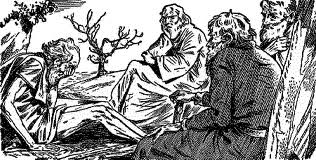
 The book of Job (pronounced with a long “O”) is viewed as a dreary story raising but not solving a haunting question — Why do good people suffer bad things?
Its writer, a wealthy man with many children, laments he had lived an exemplary life but was abandoned by God in his hour of need. His friends didn’t help much, giving him nothing but platitudes and accusing him of obviously being punished for secret sins. But he had no secret sins — even God said he was a good man! So, we’re back to wondering.
Then a new idea is revealed — a paradigm shift offered by Job’s youngest guest. We overlook the profundity of his words because we, too, are intent on finding the answer we want! Albert Einstein in 1926 once wrote:
Whether you can observe a thing or not depends on the theory which you use. It’s the theory which decides what can be observed.
Job’s youngest friend, Elihu, presents a different theory.
If you sin, what difference could that make to God? … Even if you’re good, what would God get out of that? … The only ones who care whether you’re good or bad are your family and friends and neighbors … God’s not dependent on your behavior. – Job 35:6-8 (Message)
Job, his friends, and we have an underlying premise that we somehow bless God by our faithfulness and that he (or life itself) ought to reciprocate just to be fair! — You don’t think that way?
- When we take time to pray, do we say to God, “I’m here! It’s a sacrifice on my part, but I’m here so meet with me and bless me for it”?
- When we read our Bible daily do we think God should be appreciative and should somehow show that appreciation?
- When we turn the other cheek, share Christ with someone, go to church regularly, even tithe, do we expect that God should reward us for what we are enduring for his sake?
If God did nothing for us he would be completely just and fair for he owes us nothing — Ah, but he does so much!
Your thoughts? Leave a comment.
– fritz@langgang.com.

 Patrikin - Kinship through The Father